August 13th, 2026

We’ve added a range of new features designed to help you get paid faster, spend less time following up customers and have more control over how you collect payments.
Here’s what’s now available in your Pay Advantage account.
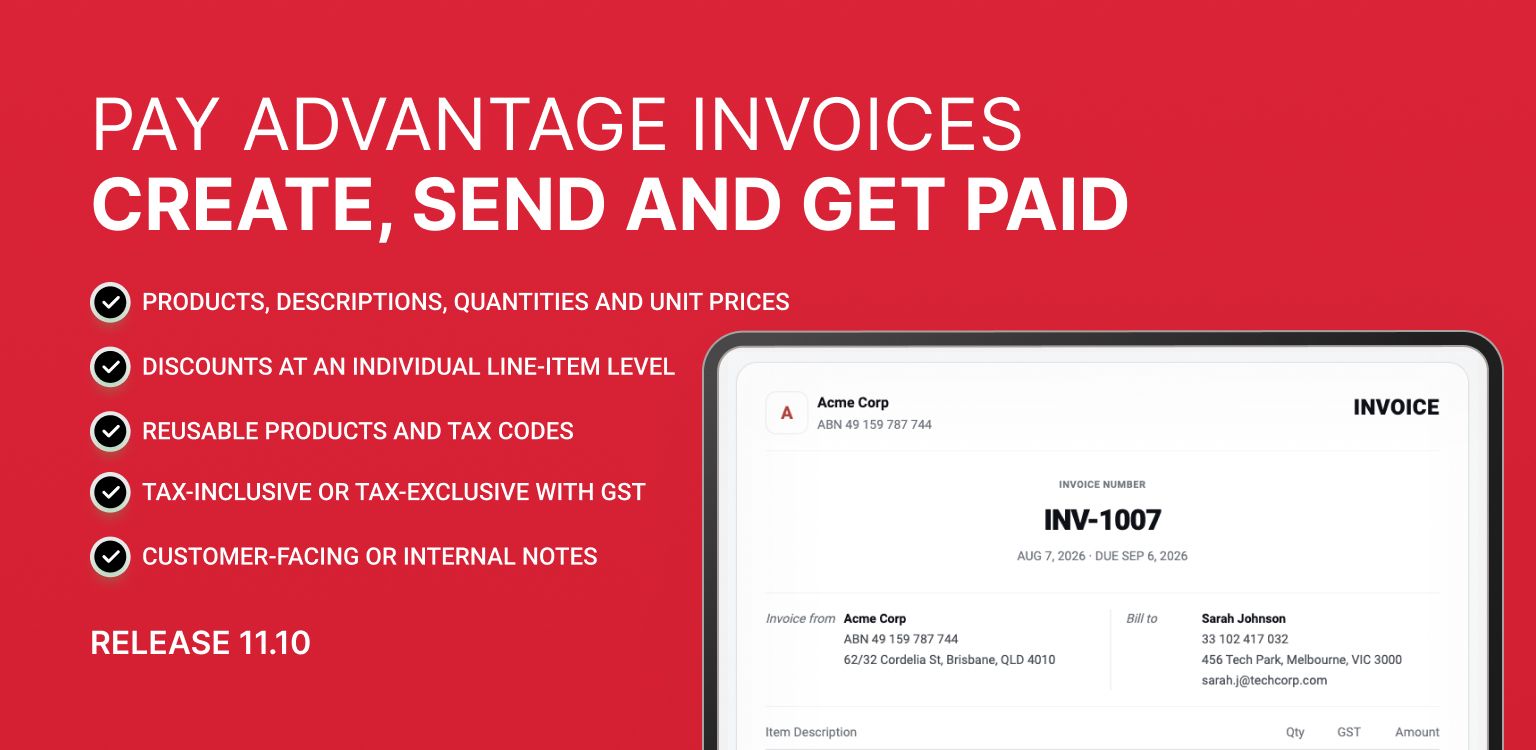
You can now create and send invoices directly from Pay Advantage. No Xero required.
Build an invoice, add your products or line items, send it straight to your customer, and get paid by Card or PayID through the same trusted Pay Advantage payment flow you already use.
Build invoices that suit your business, including:
Products, descriptions, quantities and unit prices
Discounts at an individual line-item level
Reusable Products and Tax Codes
Tax-inclusive or tax-exclusive pricing with GST automatically calculated
Customer-facing or internal notes
Invoice numbers, issue dates, due dates, references and external IDs

Once your invoice is ready, you can send it by email or SMS, share a payment link or provide a QR code for your customer to scan.
Customers can then pay securely by Card or PayID through a hosted invoice page.

Need more flexibility? You can also:
Payment Plans - Let customers pay an invoice off in installments, so a big bill doesn't turn into a bad debt.
Discounts & Credits - Show your customers their discounts and credits to encourage payments and provide clearer billing.
Attach Existing Payments - Match a payment you've already received to its invoice, so nothing gets double-handled at reconciliation.
Virtual Terminal - Take a card payment over the phone and mark the invoice paid while the customer's still on the line.
Bulk Invoice Payments - Collect against every outstanding invoice in one batch, instead of one at a time.
One View of Every Invoice - See your Pay Advantage and Xero invoices side by side, process with the system that works for you.
Once the balance is paid, the invoice automatically completes. If a linked payment is later refunded or charged back, the invoice automatically reopens so your records stay accurate.
Pay Advantage can now help with the follow-up too.
See outstanding and overdue invoices at a glance, send automatic payment reminders before and after the due date, and bulk pay eligible invoices.
You can also choose to on-charge eligible fees to your customer.
If you regularly send invoices and then manually follow up payment, this one feature will save you hours.

As soon as a direct debit clears, your customer gets their paid invoice and receipt automatically. No manual sending, no follow-up questions.
When creating a Recurring Template, you can choose to:
Generate an invoice on settlement - Automatically creating the invoice as soon as the payment settles
Automatically send the invoice to your customer - Once the invoice is created, it will email your customer the invoice and receipt pair
New Direct Debits created from that template will automatically inherit your invoicing preferences.
Set it once and let Pay Advantage take care of the rest.

Still manually chasing customers after sending a Payment Request? You may not need to.
With Smart Reminders turned on, customers are 4 times more likely to pay, helping you get paid sooner without adding more follow-up work for your team.
Smart Reminders automatically send email and SMS reminders when a Payment Request remains unpaid and is still active.
You can also set a due date on your Payment Request, making it easy to see when payment is expected. If the due date passes without payment, Smart Reminders automatically adjust their wording to let your customer know their payment is now overdue.

Reminders are typically sent around days 3, 7, 13, 25 and 45, (if a due date is set a reminder will also be send 2 days before then another on the due date and also 1 day after payment is due) keeping your payment front of mind without your team having to remember to follow up.
The Smart Reminder fee will only charged when a reminder is actually sent. So you only pay if the customer needs a follow-up.
You remain in control and can:
Set a due date for your Payment Request
Enable or disable Smart Reminders for individual Payment Requests before the first reminder is due
Your applicable reminder fee can be viewed under your Subscription Plan and Rate Plan.
Send the request once and let Smart Reminders help with the follow-up.
This feature is only available if you have enabled PayID on your account
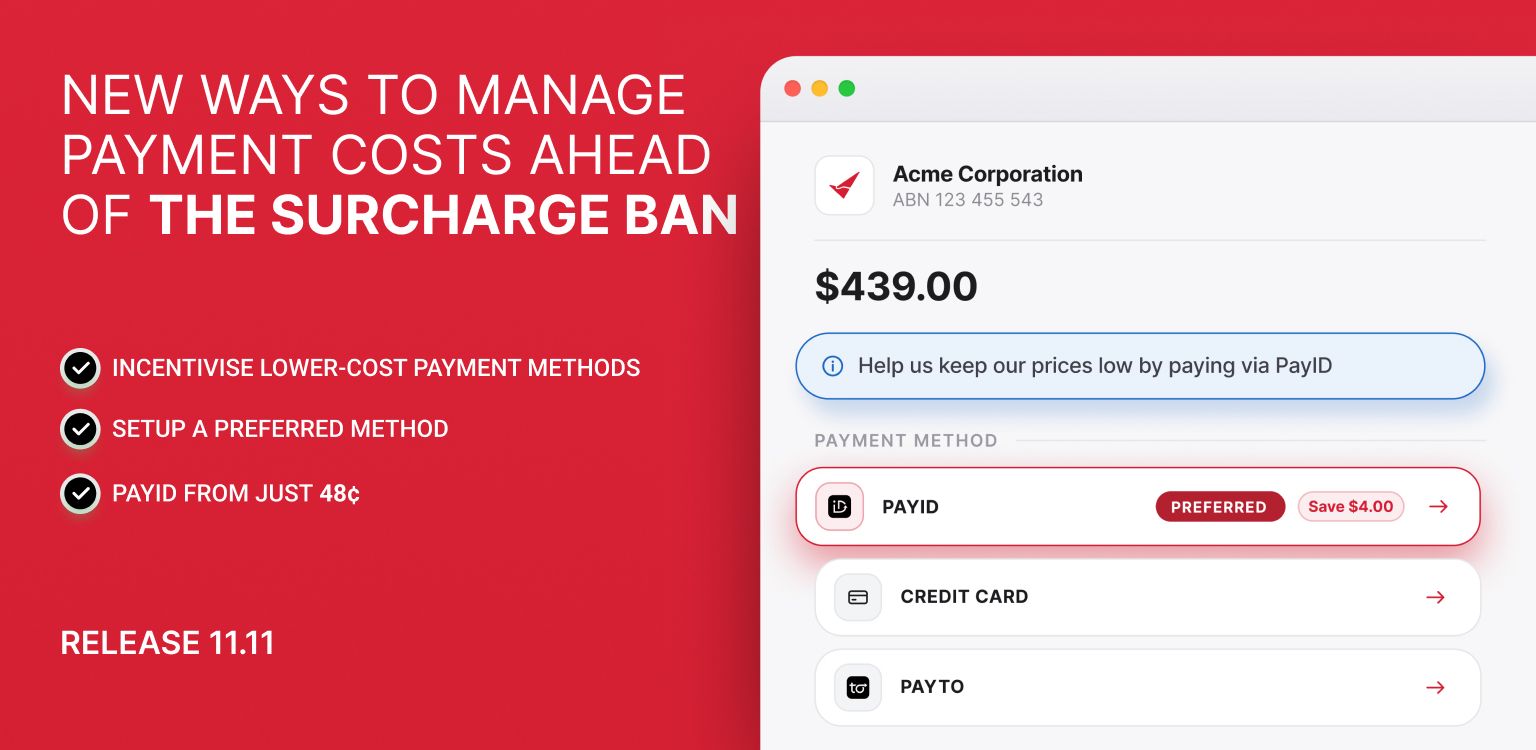
Want to reduce the cost of accepting higher-value payments? Smart PayID Redirect can help.
You can now encourage customers making larger payments to choose PayID instead of Card.
Set your preferred transaction threshold and, when a customer selects Card for a payment at or above that amount, Pay Advantage can display a customised message encouraging them to switch to PayID.
The customer still has the choice to continue paying by Card.
You decide:
Whether Smart PayID Redirect is turned on
The payment amount that triggers the prompt
What message your customer sees
For businesses accepting larger transactions, shifting even a portion of payments from percentage-based Card fees to PayID can help reduce overall payment processing costs.

Put the plans you want customers to choose front and centre.
You can now control exactly how your public Direct Debit plans appear on your Payment Portal.
Under the new Template Settings area, simply drag and drop your plans into the order you want customers to see them.
You can also:
Show or hide individual plans
Mark a plan as Recommended
Choose the exact order plans appear
Reset changes before saving if you change your mind
Your first Recommended plan is automatically brought into focus when customers visit the page.
This gives you greater control over how you present your payment options and allows you to strategically position your preferred or best-value plan rather than relying on the previous automatic price-based ordering.

If you create Direct Debits through the Pay Advantage API, there’s now a faster and simpler way to set them up.
A new API endpoint allows you to create a Direct Debit directly from a saved subscription template. The template automatically applies the:
Payment amounts
Fees
Frequency
Terms
You simply provide the customer, payment account and scheduling or authorisation options.
This means your integration can use pre-configured templates rather than supplying the same plan details each time, helping to simplify your integration, improve consistency and create Direct Debits faster.
You can also access this feature directly through the Pay Advantage user interface. When creating a Direct Debit, simply select a saved template from the Direct Debit creation slider and the plan details will be automatically applied for you.
Whether you’re creating Direct Debits through the API or directly in Pay Advantage, you can now skip repetitive setup and get new Direct Debits running faster.
These features are designed to help you get more from your Pay Advantage account, whether that’s getting invoices paid sooner, reducing manual follow-ups, lowering payment costs or making recurring payments easier to manage.
Not sure which features could make the biggest difference to your business? Our Support Team is here to help.
Give us a call on 1300 641 310 and we can talk you through the new features, help you identify which ones could benefit your business and show you how to get started.
Get in touch with our team today and start getting more from Pay Advantage.
June 16th, 2026

We've introduced Recurring Direct Debit Templates — a new way to standardise, reuse and share your most common direct debit arrangements.
Templates allow you to pre-configure recurring amounts, schedules, reminders, fees, digital agreements and more, making it faster and easier to create new direct debits while maintaining consistency across your business.
Templates can also be published to your Payment Portal, allowing customers to set up their own direct debits using template plans you've already configured. Customise how your template plans appear with descriptions, benefits, images and call-to-action text to create a more guided customer experience.

✅ Create reusable recurring direct debit templates
✅ Create new direct debits from existing templates
✅ Publish template plans to your Payment Portal
✅ Share individual template links with customers
✅ Customise template plan descriptions, benefits and imagery
✅ Track template versions and attached direct debits
✅ Manage template updates through built-in versioning
Recurring Direct Debit Templates help reduce manual setup, improve consistency, and make it easier for customers to establish direct debit arrangements through your Payment Portal.
To learn more, see our new help articles:
May 27th, 2026

We've updated the payment receipt page to improve readability and make key payment information easier to access.

The payment amount, status, customer, and payment date now appear together at the top of the receipt page for quicker visibility.

The customer name on the receipt is now clickable, allowing you to quickly open the customer profile.
Receipt information has been reorganised to better reflect the payment method used.
Some payment methods may display different transaction details depending on the information available.
When returning from a receipt back to a list view, the previously selected row is now highlighted so you can easily identify where you came from.
You can now enable or disable the on-charge fee when editing a payment request.
We’ve also added edit history tracking for payment request amount, description, and on-charge changes.
Note: the on-charge value is locked in when the hosted payment page is first loaded by the customer. Any changes made after the page has loaded will not apply to that payment session.
May 5th, 2026

You can now upload and ensure customers sign a Digital Agreement (e.g. Terms & Conditions) before they complete their Direct Debit Requests.
A new section in your Portal allows uploading a PDF version of the Digital Agreement you need your customers to sign before starting their contract
Each uploaded document requires a name to ensure a clear record of what customers agreed to on a specific date:
During authorisation:
Customers must explicitly accept the Terms & Conditions via a mandatory checkbox
A modal allows users to view the full document before accepting
After an authorisation is accepted, in your merchant portal you be able to view:
The specific version of T&Cs accepted
The date of acceptance

Repeating invoices from Xero are now clearly identified and easier to manage within the platform.
They are clearly identified in the Xero Invoices list with a dedicated icon
A new “Edit Repeating Invoice” option has been added to the invoice dropdown menu
Users can now filter/select repeating invoices more easily via a dedicated selection option to allow paying repeating invoice with one simple click

We've added new safeguards in the Customer Portal to help protect your business from fraudulent payment activity.
Custom Links and Pay Any Amount pages are now monitored for suspicious patterns, with automated checks that step in only when clear signs of fraud are detected.
This change doesn't extend to Payment Requests or Direct Debit (DDR) authorisations, which already have dedicated safeguards.
In the rare event a check is triggered, you'll see the current status in your payment portal settings. Most resolve automatically within 24 hours, and our support team is on hand if you'd like a quicker review.
2FA challenge activity is now recorded on the user record, giving you a clearer view of sign-in attempts across your account.
Customers can now be marked as inactive once all associated Direct Debit Requests (DDRs) are completed or cancelled, improving housekeeping and filtering in the system.
A customer cannot be set to inactive if they have any DDRs in Draft, Authorising, Pending, or Active status
Customers with only completed or cancelled DDRs can now be made inactive
Inactive customers are excluded from default selection when creating new payments or DDRs
March 9th, 2026

Managing invoices is now faster and easier! You can bulk pay Xero invoices directly from the invoice screen using your default customer payment account.
Key Features:
Select multiple invoices at once with checkboxes or “Select All” per page
Pay Selected Invoices button for bulk payment processing
Payment Method Column: See the last 4 digits of the default card used for payment
Invoice Status Tags:
Paid – payment completed successfully
Only invoices with a valid card can be selected
Email receipts are sent using the existing system
Process:
Select the invoices you want to pay (or use “Select All” for the current page)
Click Pay Selected Invoices
Confirm your action in the confirmation popup
A dialog box appears with a progress bar while payments are processed
Status updates to Paid or Failed once the payment has tried processing
This update makes invoice management quicker, simpler, and more efficient.
Standard direct debit credit card charges apply to bulk Xero payment processing.

The Xero setup process has been simplified. When connecting your Pay Advantage account to Xero, the branding and Pay Now button on invoices will be automatically created.

You can now add a customer address directly when creating a customer in the VT slider.
The address field supports:
Google address auto-populate for faster, more accurate entry
Manual address entry when needed

Customers can now save their payment details when paying through a payment request link, a Xero invoice, or your payment portal.
Once saved, the next time they make a payment they can simply select their saved account, complete a quick 2FA verification, and pay without re-entering their card details.
This makes repeat payments faster and more convenient for customers.
Customers remain in full control of their saved payment details and can choose whether or not to store them.
Note: This feature does not affect existing direct debit functionality.

December 10th, 2025

Xero and Pay Advantage sync errors now have information about the customer and the payment that was unable to sync. This allows you to fix the error in Xero to allow the synchronization to resume without any difficult analysis.

You can now edit an existing Payment Request without generating a new link. This makes it easier to correct details and avoids confusing customers with multiple payment links.
What’s New:
You can now open an active Payment Request and update key details directly from an Edit screen. This screen looks similar to the original creation page and allows you to adjust:
Description
Amount
Attached Credit Card

You can now quickly create a new payment based on an existing Payment Request. This feature pre-populates key details, reducing manual entry and speeding up the payment process.
What’s New:
Duplicate Payment Button: A new “Duplicate” button is available on the Payment Request slider.
Pre-populated Fields: Clicking the button opens the Virtual Terminal starting at the customer selection screen, with:
The amount from the original request
The description from the original request

Consolidated Payment Portal URL and subdomain management into a single section in Configure Payments; the displayed URL automatically uses the subdomain when one is active.

Completed or failed payment requests now include a detailed history of payment attempts. This helps you see if a customer tried to pay multiple times and makes it much easier to explain the payment activity to your customers.

November 11th, 2025

You can now easily switch between your Live (Production) and Sandbox (Test) environments, all while using your same Production login.
This update makes it simple to:
Test and explore safely in Sandbox before going live
Use your Production credentials to log into Sandbox, no separate account/login needed
Keep your user settings and data in sync between environments
Instantly recognise which environment you’re in, with clear Sandbox colouring and labels
No need to manage separate logins or accounts — just switch, test, and return to Production anytime.

Sandbox users can now choose from pre-configured test credit cards and bank accounts to simulate different payment scenarios directly in the Virtual Terminal.
Key Benefits:
Quickly test different payment outcomes (success, failure, or error scenarios) without manually entering card or bank details.
Selection automatically populates the payment form with the chosen test details.
A clear banner indicates that you are in a test environment to avoid confusion.
Dropdown and test data appear only in the Sandbox environment; production is unaffected.


A new chat feature is now available in the Help section to assist you with any issues.

Use this feature to create customised payment links that can be shared or embedded on your website. These links allow customers to pay for a product or service directly through your branded payment portal.
You can also learn how to dynamically generate these links — perfect for developers who want to automate link creation based on customer or product data.
Key Benefits:
Generate reusable payment links by entering customer information or just an amount and description.
Supports all key fields including: First Name, Last Name, Amount, Description, Payment Ref, Customer Ref, External ID, Business Name, Email, and Phone.
Links can be secured with a hash, making them tamper-proof for safer transactions.
Automatically generates a QR code for easy sharing alongside the payment link.
Simple API integration available for creating links and QR codes programmatically.
Past links are visible in a table showing the most recent 10 links, making management and reuse easy.
Note:
Custom Payment Links are different from Payment Requests.
Payment Requests are created through the Virtual Terminal.
They are trackable within your account.
They are automatically marked as completed once payment is received.
Custom Payment Links, by contrast, are static or dynamically generated URLs that don’t automatically track the individual payment status — ideal for general payments or online checkout scenarios.

October 31st, 2025

PayID is a new payment method that allows your customers to pay you instantly using just an email address - no need to share bank account details or use credit cards. It's a secure, real-time payment system that works directly through your customer's online banking or mobile banking app.
To enable PayID on checkout or payment requests, please reach out to our support team for enablement.

For more information: What’s PayID article ?
Customer code search functionality across customer, admin, and merchant admin screens.

Added the ability to attach a Customer Payment Account (CPA) to an existing Payment Request.
Previously, a CPA could only be linked when creating a new Payment Request.
With this update, a new button now allows you to attach a CPA even after the Payment Request has been created.

The API now includes the payment status in its response when a request is made. This is an attribute called status on the payment API call.
Refer to the documentation here:
https://docs.payadvantage.com.au/docs/payment-statuses
Enables merchants to decide whether to verify a customer’s payment card during account setup, supporting PCI-DSS compliance.
What’s new:
Added a “Verify Card” toggle when adding a Customer Payment Account.
The toggle lets the merchant choose whether card verification is performed.
If the toggle is changed after the credit card iframe has been initialised, the iframe will re-initialise to reflect the new setting.
The toggle label clearly states:
Verify Card – A fee is associated with card verification

Adds a merchant-controlled setting to prevent the creation of new customers via Hosted Pages or the Payment Portal. This addresses merchant requests to stop customers from creating their own records from malformed or unauthorised links.
How it works:
New Setting: Found in the Hosted Pages section of merchant settings.
When enabled:
Hosted Pages and the Payment Portal will only process payments against existing customers (identified by External ID, Customer Reference Number, or BPAY Number).
No new customer records will be created.
If someone attempts a payment that would require creating a new customer, they will see:
“Sorry, this merchant is unable to take payments in this way. Please contact the merchant.”
When disabled: Current behaviour remains – new customers can be created if required.
Customer updates still allowed: Existing customers without required details (e.g., email/mobile) will be prompted to update them before proceeding.
Xero integration unaffected: Payments and links for Xero customers continue to work.
July 9th, 2025

🚀 Introducing the New Pay Advantage Mobile App – Now on iOS & Android!
We’ve just officially launched the mobile app you’ve been waiting for – packed with all the Pay Advantage features you know and love, now in your pocket.
Whether you're on the road, in-store, or at home, our new app gives you instant access to everything you need:
💸 Real-time push notifications for payments and settlements – know the moment a payment is made through your hosted page or payment link.
💰 Start your day with confidence – get alerted every morning with what’s landing in your bank account with settlement push notifications.
⚡ Quick actions, simplified – with an intuitive menu, you’re just a tap away from creating a payment, checking your dashboard, managing customers, setting up direct debits, or sending a payment request.

Simple. Fast. Powerful.
Download the app today on iOS and Android. We already have 576 installs of the app already!
June 22nd, 2025

We've updated notification settings to make it easier for you to choose the email and push notifications you want to receive.


PayAdvantage is enhancing how custom fields work for customer records. Previously, custom information such as department, type, or total spent could be submitted but not retrieved via the API, and only visible in the UI.
With this update, you can now view, add, and update custom field values via the API. This data will appear when retrieving customer or payment details, making it easier for merchants to track the information that matters most.
In the app, custom fields now display their actual names, no more confusing labels like “Custom Field 1.”
For more information, go to the Customer Field page.

Change Payment Account links are sent out without any reminders if they are not followed. This implements reminders to be sent out.
Webhook searches now support searching by webhook code, allowing you to quickly find and resend specific events when troubleshooting.